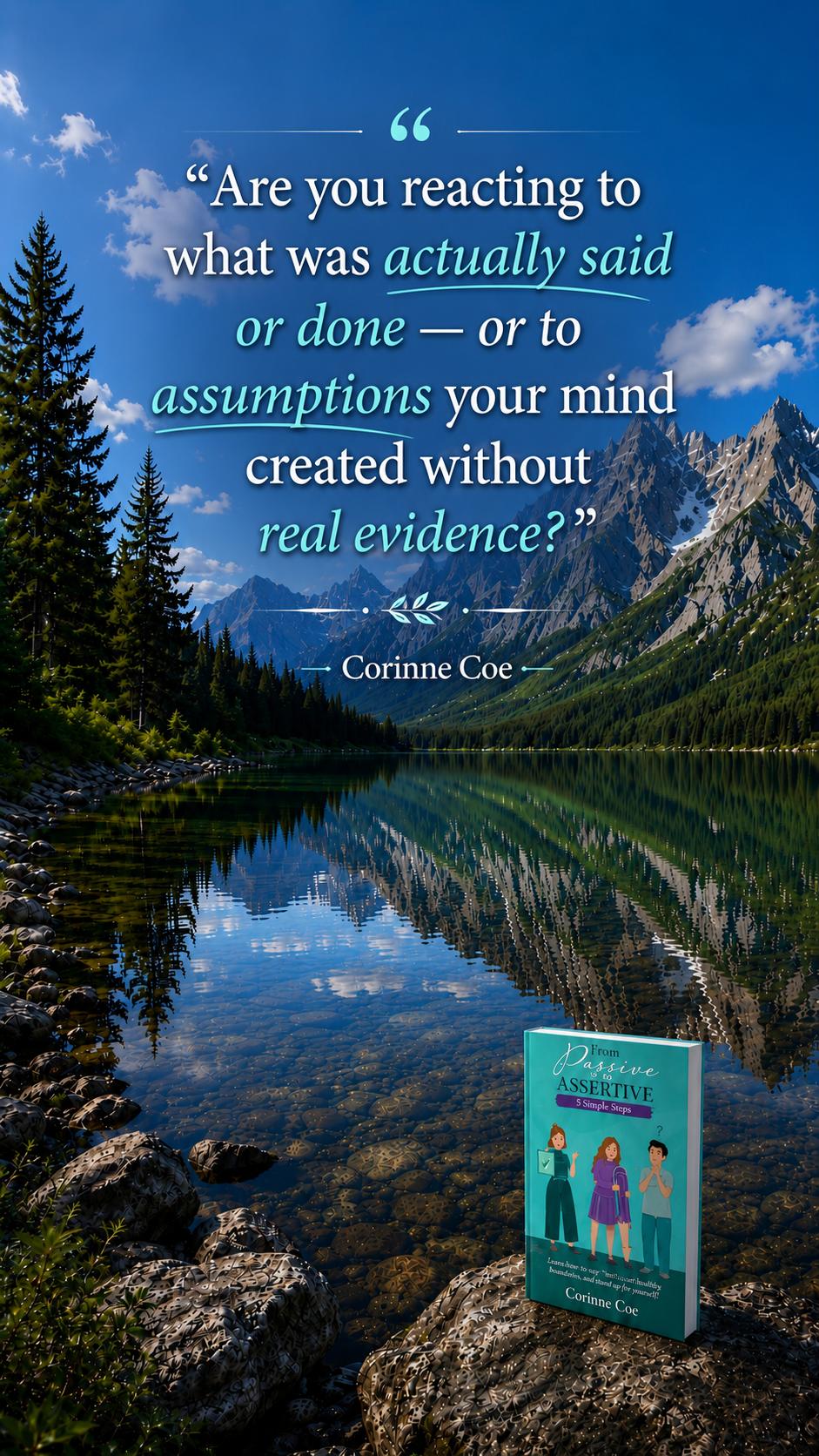
Many people unintentionally react not only to what actually happened, but to the meaning, intention, fear, assumption, or story they attach to the situation. The mind naturally tries to “fill in the gaps” whenever information feels unclear, uncertain, emotional, or potentially threatening. Unfortunately, the stories we create are not always accurate.
Human beings dislike uncertainty. The brain is constantly trying to predict outcomes, understand intentions, and keep us emotionally safe. When information is missing, the brain often creates an explanation rather than tolerating not knowing. Sometimes those explanations are correct. Other times they are influenced by anxiety, past experiences, insecurities, fears, or emotional wounds.
For example:
- Someone replies with a short text message and you assume:
“They must be angry with me.”
In reality, they may simply be busy, stressed, distracted, tired, overwhelmed, driving, working, or not in the mood to write a long response. - Someone looks serious or quiet around you and you assume:
“They don’t like me.”
Yet they may be anxious, shy, socially uncomfortable, preoccupied, exhausted, or dealing with personal problems that have nothing to do with you. - Someone cancels plans and you assume:
“They don’t value me.”
When they may genuinely be unwell, overwhelmed, emotionally drained, or managing competing responsibilities. - Someone gives constructive feedback and you interpret it as:
“I’m a failure.”
Instead of seeing it as information about a specific behaviour, performance issue, or situation that can be improved. - A friend takes longer than usual to respond and you think:
“They’re pulling away from me.”
Even though there may be many alternative explanations that have nothing to do with the relationship.
Why the Brain Does This
The brain evolved to detect potential threats. Thousands of years ago, quickly identifying danger helped people survive. The problem is that modern emotional threats, such as rejection, criticism, embarrassment, exclusion, or disapproval, can activate many of the same alarm systems.
When people struggle with:
- overthinking
- anxiety
- low self-worth
- rejection sensitivity
- insecurity
- people-pleasing
- abandonment fears
- past emotional wounds
- trauma
their brain often becomes highly alert to signs of possible rejection, criticism, conflict, or loss.
As a result, neutral situations can be interpreted negatively before enough evidence exists to support the conclusion.
The brain begins asking:
- “What if they don’t like me?”
- “What if I did something wrong?”
- “What if I’m being rejected?”
- “What if this means something bad?”
Over time, these assumptions can feel so believable that people mistake them for facts.
The Problem With Emotional Interpretation
The danger is that we often respond to our interpretation rather than the actual situation.
For example:
A person may feel rejected, become upset, withdraw, over-explain, seek reassurance, become defensive, or start an argument based entirely on an assumption that was never confirmed.
In relationships, this can create unnecessary conflict because people end up reacting to imagined intentions rather than actual evidence.
A short text becomes:
“They’re angry.”
A cancelled plan becomes:
“I don’t matter.”
A serious facial expression becomes:
“They dislike me.”
The emotional reaction feels real because the story feels real—even when the evidence is limited.
Facts vs Stories
A healthier approach is learning to separate facts from interpretations.
For example:
Fact:
“They haven’t replied to my message.”
Story:
“They’re ignoring me because I’m unimportant.”
Fact:
“My manager gave me feedback.”
Story:
“I’m terrible at my job.”
Fact:
“They seemed quiet today.”
Story:
“They must be upset with me.”
Learning this distinction can dramatically reduce anxiety, overthinking, and unnecessary emotional suffering.
Helpful Questions to Ask Yourself
Before jumping to conclusions, try asking:
- What objective evidence supports this belief?
- Am I assuming intention without proof?
- What facts do I know for certain?
- Could there be multiple explanations?
- Am I reacting to evidence or to fear?
- Would another person necessarily reach the same conclusion?
- Am I mind-reading?
- Am I catastrophising?
- Have I gathered enough information to make this judgment?
A More Balanced Way of Thinking
Instead of:
“They ignored me because I don’t matter.”
Try:
“I noticed they haven’t replied yet, but I don’t have enough information to know why.”
Instead of:
“They criticised me because I’m a failure.”
Try:
“I received feedback about one behaviour or situation. That doesn’t define my worth as a person.”
Instead of:
“They seemed distant, so they must not care about me.”
Try:
“Something seems different today, but I need more information before I decide what it means.”
Gather Evidence, Not Assumptions
Emotionally healthy thinking is not about ignoring problems, dismissing concerns, or pretending everything is fine.
It’s about allowing evidence, not fear, to guide conclusions.
Healthy evidence gathering includes:
- looking for patterns rather than isolated incidents
- asking clarifying questions
- communicating directly when appropriate
- observing behaviour over time
- separating facts from interpretations
- considering alternative explanations
- checking whether emotions are influencing perception
- seeking objective perspectives when needed
One incident rarely tells the whole story. Patterns are often far more informative than isolated moments.
The Goal
Emotionally healthy thinking is not:
“Everything is my fault.”
Nor is it:
“Everyone is against me.”
It is:
“I will look at the evidence, context, patterns, and facts before deciding what something truly means.”
The more you learn to separate reality from assumption, the less power fear, insecurity, and overthinking have over your emotions. Often, the suffering comes not from what actually happened, but from the story we unknowingly created about it.
📚 If you’d like additional support in changing negative, catastrophic, or self-defeating thinking patterns, my book, Think Positive Feel Positive, offers 55 carefully designed affirmations and reflections to help you challenge unhelpful thoughts, develop healthier perspectives, and create a more positive mindset over time. Created by a psychologist, it’s designed specifically for overthinkers, worriers, and anyone wanting to improve their mental well-being. Think Positive Feel Positive can be purchased from Amazon.com (US/Worldwide) and Amazon.com.au (AU)
From Passive to Assertive can also be purchased from Amazon.com and Amazon.com.au
Corinne Coe, Author/Psychologist